


In my daily work as a lead generation and qualification specialist, one question frequently arises: after all, which channel brings better sales results, WhatsApp or Telegram? With 2026 approaching and the accelerated digital transformation, understanding the landscape has become even more relevant. The direct answer is: it depends. But the nuances go far beyond common sense, and I want to share my experience and what I've been mapping with recent data, trends, and, of course, firsthand experience at Lead2Go.
WhatsApp's Dominance: Impressive Numbers
It's impossible to start this comparison without mentioning WhatsApp's absolute dominance in Brazil.
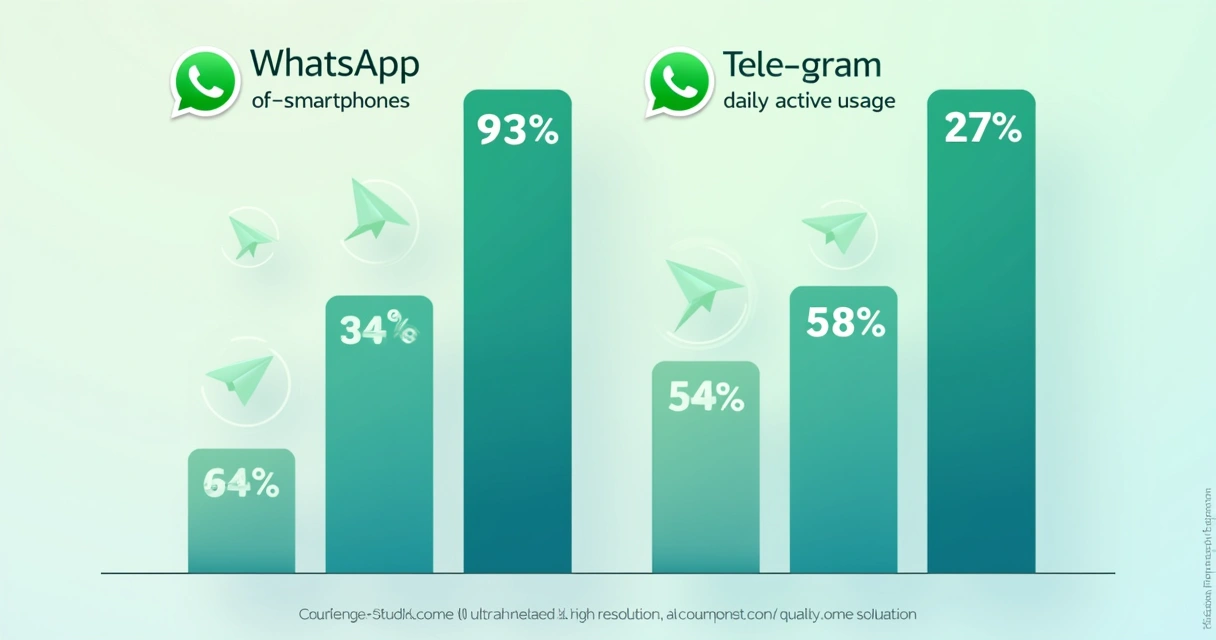
According to Statista research, it's present on no less than 99% of Brazilian smartphones, with 93% of people accessing the app daily. And it goes further: 75% of Brazilians have already purchased services via WhatsApp and 68% have bought products directly through the app (Statista research).
It's no coincidence that WhatsApp has become synonymous with communication; it's that "send it to me on Zap" we hear in any context. It has simplified processes, accelerated response cycles, and given prominence to personalized conversations. That's why companies using platforms like Lead2Go can standardize, automate, and personalize customer service on this interface, amplifying all the advantages of the most populous channel in the country.
Another point that caught my attention recently was an article by Canaltech showing that 34% of Brazilians keep WhatsApp open all the time, while 61% access it several times a day (Opinion Box research).
WhatsApp is part of the routine like brushing your teeth.
This scenario opens up a sea of opportunities, especially for companies that need speed in responses and active relationship building.
Telegram's Growth and its Engaged Audience
On the other hand, I've seen Telegram grow in recent years. Reports indicate that today it's installed on about 57% of smartphones in the country, but only 27% of Brazilians actively use the app (Statista report). Even so, this represents a consistent rise, especially in more segmented groups and audiences seeking communities and privacy.
I often see Telegram very strong in niches like technology, marketing, cryptocurrencies, and sectors that value differentiated features, such as overcrowded groups, sophisticated automations, and sending large files. It's a channel that appeals to those who like to explore advanced functions, bots, and integrations.
Despite everything, I say without mincing words: Telegram is still not the massive channel for lead acquisition and accelerated response that WhatsApp represents.
Conversion Rate: Where Are the Real Differences?
This is the most sensitive point for those who seek me out at Lead2Go and for those looking for tangible returns. I've tracked hundreds of campaigns, and on average, WhatsApp shows considerably higher conversion rates. The reason is simple: more access, instant notifications, and an audience already educated to negotiate, ask questions, and buy through the app.
On Telegram, the sales funnel tends to be longer, as the impact of notifications is lower, and the response doesn't always come at the expected pace.
- Instant Notifications: WhatsApp delivers more "urgent" notifications, generating quick interactions and higher response rates.
- Ease for audio, documents, and links: Everything integrated, familiar, and agile, without the need to download new apps.
- Lower barrier to entry: WhatsApp is almost a national standard; Telegram still requires an extra step in the common consumer's routine.
If you are in markets that demand volume and speed, the choice tends to be clear. But if your audience is ultra-segmented, Telegram might surprise you with engagement in selected groups.
The Role of Automation and Artificial Intelligence in the Right Channel
This point deserves highlighting. It's useless for a channel to be popular if the company loses leads due to delays, garbled messages, or lack of context. This is where platforms like Lead2Go ensure a performance leap: by integrating artificial intelligence that respects your brand's tone, responds quickly, and transfers to a human at the right time, the platform enhances conversion on both channels.
I've noticed that in the projects I participate in, AI provides:
- Instant 24/7 responses;
- Automated contact qualification at the moment of conversation;
- Sales-ready leads directed to the sales team, without wasting time.
To delve deeper into the topic of WhatsApp automation, I recommend the content on how to integrate AI into WhatsApp customer service, with practical tips from Lead2Go.
Leads, Metrics, and Performance Analysis in 2026
Finally, people ask me, how do I measure if I'm converting well on each channel? The answer lies in analyzing specific lead qualification reports, comparing response metrics, service time, and funnel progression.
It's essential to look at indicators such as:
- Average response time;
- Lead qualification rate;
- Conversion to sale rate;
- Abandonment rate;
- Customer satisfaction during service.
Lead qualification reports must be transparent and offer practical data for process adjustments. I recommend in-depth content on the blog about how to analyze qualification reports, very useful for those looking to maximize results.
When is it Worth Investing in Both Channels?
In my view, integrating WhatsApp and Telegram makes sense when you can segment intelligent campaigns according to your audience's profile.
The dual strategy is interesting in situations such as:
- Niche events and launches, when Telegram adds value to engaged communities.
- Volume campaigns, where WhatsApp handles the "bread and butter" for the lead mass.
- Tests of new markets and profiles that deviate from the conventional.
However, on average, I recommend concentrating efforts on WhatsApp, gaining scale, automation, and personalization, as with Lead2Go. The numbers support this strategy, and with AI, the result gains another dimension.
The best channel is where your lead is, but also where you don't miss opportunities due to a lack of efficient response.
Lead2Go's Differentiator in the Market
Even though there are automation alternatives for both applications, few platforms master the combination of personalized artificial intelligence, clear metrics, and smooth handover to the human team. I see competitors who focus only on volume but falter in personalization and don't help build long-term relationships.
At Lead2Go, every stage of customer service is monitored: you see where each lead is, with protected data and continuously optimized performance, whether on WhatsApp or Telegram. And the best part: the AI's learning happens based on your business's day-to-day operations, something rare in the competition.
If you are looking to increase conversions, I highly recommend delving into the content about sales with AI and also about trends in artificial intelligence for marketing. These topics help understand these movements with a practical perspective.
WhatsApp remains unbeatable as a mass channel, with Telegram growing in niches. But the secret is not to lose any leads, and only the right technology can guarantee that.
Conclusion: The Channel That Converts More Leads in 2026
After so much analysis, data comparison, and trend monitoring, my conclusion is clear: in 2026, WhatsApp continues to be the channel with the highest lead conversion in Brazil, especially when integrated with automation and artificial intelligence.
Telegram serves its purpose for specific audiences and can be part of complementary strategies, but in the vast majority of cases, it's on WhatsApp that conversations quickly turn into sales.
Want to see in practice how Lead2Go can transform your contacts into sales on the right channel? Schedule a 30-minute call and discover how to respond, qualify, and convert more leads, without wasting time or opportunities in 2026.
Frequently Asked Questions about Lead Conversion on WhatsApp and Telegram
Which channel generates more leads in 2026?
WhatsApp remains the main lead generator in 2026 in Brazil, appearing on virtually all smartphones, while Telegram grows but stands out more in specific segments. Companies operating with large-scale sales and automated customer service continue to find a constant source of new contacts on WhatsApp.
Does WhatsApp or Telegram convert faster?
WhatsApp converts leads faster due to its daily frequency of use, immediacy of notifications, and greater public familiarity with purchases and negotiations via the channel. Telegram is efficient in niches or groups but tends to have a slower response on average across sectors.
How to measure lead conversion?
To know if conversion is good on any channel, you should track indicators such as average response time, lead qualification rate, sales conversion rate, and customer satisfaction during interaction. Monitoring transparent reports, like those offered by Lead2Go, makes all the difference in adjusting and improving the process.
Is it worth investing in both channels?
Yes, provided there is sufficient volume and segmented audiences that benefit from the unique characteristics of each channel. The ideal approach is to use WhatsApp as the base for the lead mass and Telegram as support for specific niches or differentiated actions.
How to improve WhatsApp conversion?
You can increase WhatsApp conversion by integrating automation and AI solutions, which ensure quick responses, personalized service, and efficient routing of leads to the human team when necessary. Platforms like Lead2Go optimize this entire journey, reducing losses and accelerating closings.